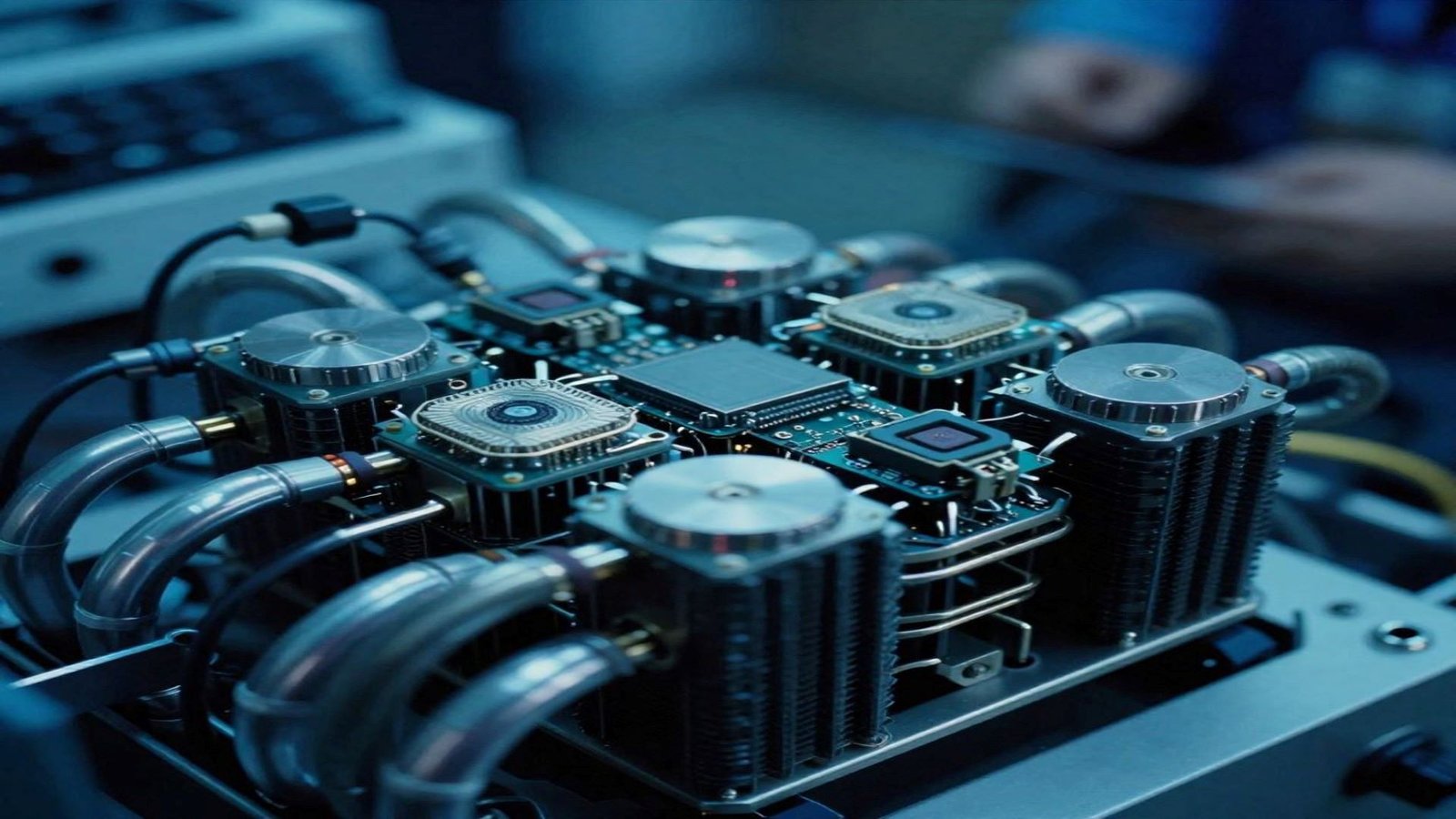
The cutting edge of global technology often sounds like science fiction—until it becomes economic reality. Hidden inside a Google research facility in Santa Barbara, California, a machine named Willow is redefining what computing power means for the future of humanity.
Willow is not a laptop, server, or supercomputer in the traditional sense. The system operates without a screen, keyboard, or mouse, relying entirely on specialised quantum controls.The system operates without a screen, keyboard, or mouse, relying entirely on specialised quantum controls. Instead, it is a quantum computer—currently regarded as one of the most powerful ever built—capable of solving problems that would take classical computers longer than the age of the universe.
What Is Willow?
Willow lives deep inside Google’s Quantum AI laboratory. Visually, it resembles a golden chandelier, suspended from the ceiling, surrounded by contemporary art and graffiti-style murals. Each quantum machine at the facility is given a name—such as Yakushima or Mendocino—reflecting Google’s effort to humanise an otherwise alien-looking technology.
BBC economics editor Faisal Islam famously described Willow as containing “the coldest place in the known universe”—and that is no exaggeration.
At its core, Willow consists of a quantum microchip submerged in a bronze-coloured liquid helium refrigerator. The system cools the chip to one-thousandth of a degree above absolute zero, a temperature colder than deep space. Hundreds of black control wires descend into the chamber, controlling the delicate quantum states inside.
Why Temperature Matters in Quantum Computing
Quantum computers rely on phenomena that do not exist in everyday physics, such as superposition and quantum entanglement. These effects are extremely fragile and collapse under even minimal heat or vibration.
By cooling the system to near absolute zero, Willow allows quantum bits—known as qubits—to maintain their quantum states long enough to perform calculations that classical computers simply cannot.
The Power of Qubits Explained
According to IBM, a qubit is the quantum equivalent of a classical computer bit.
- A traditional bit can exist as either 0 or 1
- A qubit can exist as 0 and 1 simultaneously (a state called superposition)
This property allows quantum computers to process vast combinations of information at once.
Willow currently operates with 105 superconducting qubits, a significant milestone in the field. By comparison, Microsoft’s quantum program currently operates with far fewer qubits, using a different technological approach.
However, the real goal across the industry is reaching one million error-corrected qubits—a threshold that would enable “utility-scale” quantum computing for chemistry, materials science, and drug discovery.
Solving the Impossible
According to Google’s Quantum AI chief Hartmut Neven, Willow has settled the long-standing debate over whether quantum computers can outperform classical machines in meaningful ways.
Willow recently solved benchmark problems within minutes that would have taken the world’s most powerful classical supercomputers:
- Trillions of years in one test
- 10 septillion years in another—far longer than the age of the universe
These results are not theoretical simulations. They demonstrate real computational advantages using quantum algorithms impossible for classical systems.
Quantum Echoes and Real-World Impact
One of Willow’s most important achievements was applying a theoretical breakthrough to the Quantum Echoes algorithm—a method that helps scientists understand molecular structures.
This has practical implications in fields such as:
- Drug discovery
- Chemical engineering
- Medical imaging, including technologies related to MRI machines
In simple terms, quantum computers like Willow can model molecules exactly as they behave in nature—something classical computers struggle to do accurately.
Why This Matters for Humanity
Neven believes quantum computing could help solve some of humanity’s most urgent challenges.
“It has the potential to dramatically speed up the discovery of new medicines,” he explained in an interview with the BBC.
“It will help make food production more efficient, help us produce, transport, and store energy—and address climate change and human hunger.”
By understanding nature at its most fundamental level, quantum computers could unlock breakthroughs in renewable energy, sustainable agriculture, and advanced materials.
A Simple Way to Understand Quantum Speed
To grasp the power of quantum computing, consider this analogy:
- A classical computer searches for a tennis ball by opening one drawer at a time
- A quantum computer effectively opens all drawers simultaneously
Or imagine needing 100 keys to open 100 doors in traditional computing—quantum computing allows all doors to open instantly with a single key.
Error Correction: The Biggest Breakthrough
Despite their power, quantum computers are notoriously prone to errors. Even minor disturbances can disrupt calculations.
According to Sir Peter Knight, Chair of the UK’s National Quantum Technology Programmes Strategy Advisory Board, Willow represents a turning point.
According to him, previous quantum systems have functioned mainly as trial models rather than practical computing tools.
Until now, most quantum computers have remained experimental, functioning largely as proof-of-concept models. Willow, however, marked a breakthrough by successfully demonstrating practical error correction, where repeated repair cycles actively enhance computational accuracy rather than degrade it.
This ability to detect and fix errors is essential for scaling quantum systems into practical tools.
Nobel-Winning Science Behind Willow
Several researchers involved in the Willow project have recently received Nobel Prizes for their foundational work on superconducting qubits—the technology at the heart of Google’s quantum approach.
Their research laid the groundwork for making quantum systems stable, controllable, and scalable.
Not a Device for Everyone—But for Everyone’s Future
Quantum computers will not replace smartphones, laptops, or AI glasses. They will remain large, specialised machines housed in dedicated facilities.
However, their impact will be felt everywhere—from medicine and finance to energy and national security.
The key difference is exponential growth. As qubit counts rise and error correction improves, the power of quantum machines increases at a pace unmatched by classical computing.
The Dawn of a New Computing Era
Willow represents more than a technological achievement. It signals the beginning of a new era where problems once considered unsolvable may finally yield answers.
With governments, tech giants, and research institutions worldwide investing heavily in quantum technology, the race is no longer theoretical—it is already underway.
And while Willow may operate in silence, without screens or keyboards, its influence could soon reshape the world as we know it.