Building a Stronger Adult Social Care Workforce in the UK: Recruitment, Retention and Leadership
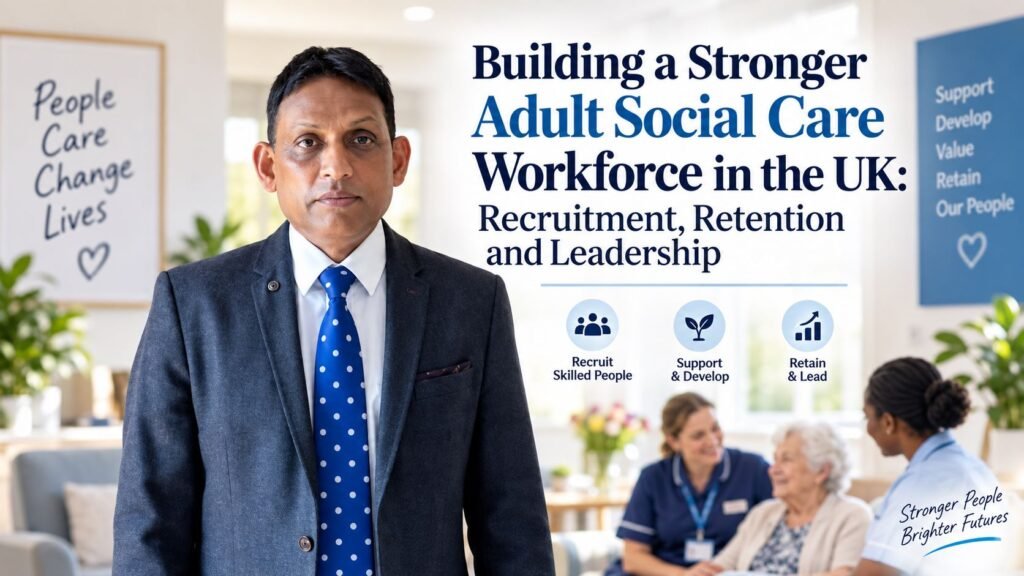
The strength of adult social care depends on the people who deliver it. Care workers, support workers, registered managers and specialist staff provide essential support every day, yet employers continue to face pressure around recruitment, retention and workforce development.
Skills for Care reported in June 2026 that the vacancy rate in England’s adult social care sector fell to 6.2% in 2025/26, the lowest level for a decade. Even so, this still represented around 96,000 vacancies on any given day, and the vacancy rate remained around three times higher than in the wider economy. Building a stronger adult social care workforce therefore requires more than filling empty posts.
Recruitment Must Focus on the Right People
Recruitment remains essential, but constantly replacing people who leave is costly and disruptive. Skills for Care’s 2025 workforce report estimated a turnover rate of 23.1%, equivalent to around 335,000 leavers in 2024/25. It also found that 53% of recruitment came from within adult social care, showing how often employers compete for people already working in the sector.
A stronger recruitment strategy starts with finding people whose values and behaviours fit care work. Skills for Care recommends values-based recruitment, which looks beyond qualifications to explore a candidate’s motivations, attitudes and approach to supporting others.
Clear job descriptions and realistic expectations also matter. Recruitment should be viewed as the first stage of retention.
Retention Starts With the Employee Experience
Keeping experienced staff supports continuity, trusted relationships and more consistent care. Skills for Care identifies secure employment, fair pay and conditions, supportive leadership, positive workplace culture, access to learning and clear career opportunities as important retention factors.
The first months of employment are particularly important. A well-planned induc
tion should help new starters understand policies, values, expectations and person-centred care. Regular supervision should then provide opportunities to discuss workload, wellbeing, performance and professional development.
Staff who feel valued and respected are more likely to see adult social care as a long-term career.
Clear Career Pathways Can Strengthen Retention
The Care Workforce Pathway is designed to make development routes clearer by setting out the knowledge, skills, values and behaviours associated with different roles.
Updated in July 2026, the pathway now covers 18 role categories and provides a career structure for around 1.5 million adult social care workers in England. Roles include people new to care, care and support workers, supervisors, practice leaders, deputy managers, registered managers and supporting roles.
The Department of Health and Social Care says organisations using the pathway have reported clearer development opportunities, more consistent appraisals and improvements in recruitment and retention.
For employers, this makes development conversations more practical and helps staff understand what they need to progress.
Strong Leadership Is Essential for Workforce Stability
Recruitment campaigns and training programmes will have limited impact if workplace leadership is weak.
Skills for Care identifies organisational culture and leadership among the strongest influences on retention. Effective leaders communicate clearly, listen to concerns, recognise good work and create an environment where staff can learn and improve.
Leadership is not limited to senior managers. Team leaders, practice leaders, deputy managers and experienced care workers can all influence culture through how they support colleagues and respond to challenges.
In 2026, Skills for Care refreshed its Leadership Qualities Framework, reinforcing the importance of strong leadership across adult social care. Skills for Care also highlights links between effective leadership, staff retention and workforce wellbeing.
Wellbeing Should Be Part of Workforce Planning
Adult social care can be emotionally and physically demanding. Workforce planning should therefore include staff wellbeing.
Managers can help by monitoring workloads, encouraging open conversations, making supervision meaningful and responding constructively when staff raise concerns. Predictable rotas where possible, recognition, flexible working and access to support can also strengthen the employee experience.
Recent government workforce research is examining factors including wellbeing, working conditions, career plans and what makes employees remain in or leave adult social care, highlighting how closely workforce stability is connected with the overall quality of working life.
A healthy culture also depends on employees feeling safe to speak up. Visible and approachable managers can identify problems earlier, before they contribute to burnout, absence or staff leaving.
From Short-Term Staffing to Long-Term Workforce Strategy
A sustainable adult social care workforce needs a long-term approach built around attraction, retention, development and leadership.
Providers can review where employees leave, how long new starters stay and whether exit feedback reveals recurring problems. Workforce data should then guide action.
Recruitment can focus on values and realistic expectations. Retention can be strengthened through induction, fair treatment, learning and career development. Leadership development can ensure managers have the skills to support people as well as services.
This also reflects the Workforce Strategy for Adult Social Care in England, which focuses on attracting and retaining people, developing skills and transforming the workforce to meet future needs. By July 2026, Skills for Care reported that three quarters of its 56 workforce strategy recommendations and commitments were already complete or in progress.
Conclusion
Building a stronger adult social care workforce is not simply about recruiting more people. It is about creating jobs people want to join, workplaces they want to remain in and careers in which they can grow.
The fall in vacancy rates is positive, but continuing workforce pressures show that recruitment alone is not enough. Sustainable progress will depend on better employee experiences, clearer career pathways, high-quality development and effective leadership.
When recruitment, retention and leadership work together, care providers are better placed to build stable teams, support staff wellbeing and deliver consistent, person-centred care.