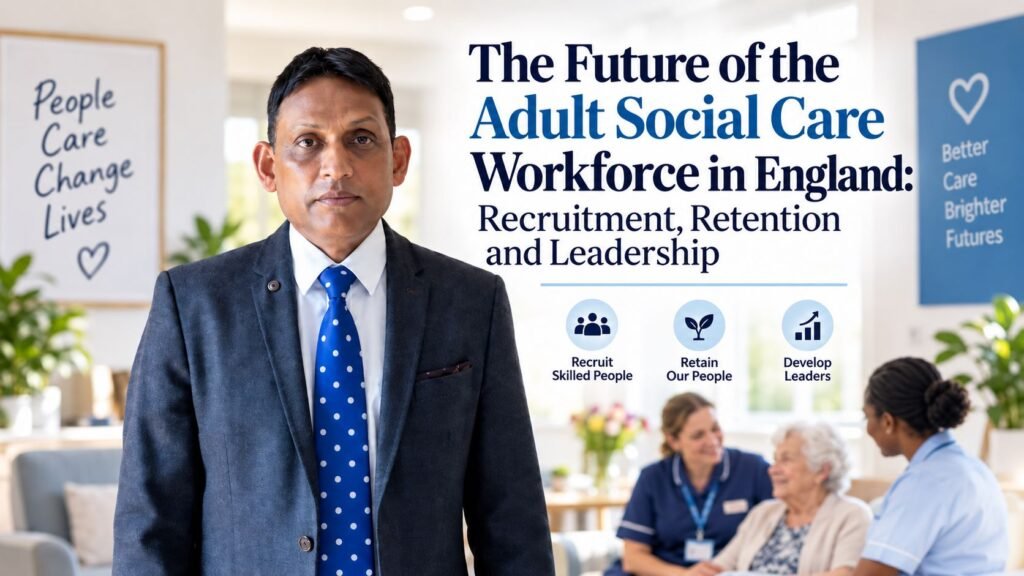
The Future of the Adult Social Care Workforce in England: Recruitment, Retention and Leadership
The adult social care workforce in England is entering an important period of change.
Demand for care continues to grow, the complexity of people’s needs is increasing and providers must compete with other sectors for employees while maintaining safe, compassionate and person-centred services.
At the same time, there are signs of improvement.
Skills for Care reported in June 2026 that the adult social care workforce had expanded for the fourth consecutive year. The vacancy rate fell to 6.2% in 2025/26, its lowest level for around a decade, representing approximately 96,000 vacant posts on any given day.
That is significant progress, but it does not mean the workforce challenge has disappeared.
Adult social care vacancies remain substantially higher than those seen across the wider economy, while providers still need to address recruitment, retention, pay, skills development, leadership and long-term career progression.
The future of social care will therefore depend not simply on attracting more people into the sector, but on creating an environment where talented employees can build sustainable careers.
Understanding the Scale of the Adult Social Care Workforce
Adult social care is one of England’s largest employment sectors.
The government describes a workforce of around 1.5 million people supporting individuals across residential care, nursing care, home care, supported living and other services.
These workers support older people, disabled people and others who require assistance to maintain independence, dignity and quality of life.
The workforce includes far more than care workers.
Registered managers, deputy managers, activity coordinators, personal assistants, care technologists, learning and development professionals, administrators, catering teams, maintenance employees and quality-assurance professionals can all contribute to the effective delivery of social care.
This broad range of roles makes workforce planning increasingly complex.
Care providers need to think not only about how many employees they require but also about whether those employees possess the right combination of skills, experience, values and leadership capability.
Recruitment Is Improving, but the Challenge Remains
The fall in vacancies is encouraging.
Skills for Care reported that the vacancy rate fell from 7.0% in 2024/25 to 6.2% in 2025/26. In numerical terms, this represented approximately 96,000 vacancies in the latest reporting period.
However, care providers should avoid interpreting this improvement as the end of the recruitment challenge.
The sector still competes for employees with retail, hospitality, healthcare and other industries that may offer alternative working patterns, career opportunities or remuneration.
Recruitment also needs to focus on suitability rather than simply filling vacancies.
Strong adult social care professionals require qualities such as compassion, patience, communication skills, accountability and respect for the independence of people receiving care.
Recruiting someone quickly but losing them a few months later can increase costs, place additional pressure on existing employees and undermine continuity of care.
Providers therefore need to strengthen the entire recruitment journey.
Clear job descriptions, realistic information about responsibilities, structured interviews, effective induction and early support can all influence whether a new employee develops into a long-term member of the organisation.
Retention May Be Even More Important Than Recruitment
Hiring more people is only one part of workforce sustainability.
Retention is equally important.
Skills for Care’s 2025 workforce report estimated an overall turnover rate of 23.1% for directly employed adult social care staff during 2024/25. Approximately 335,000 people left their jobs during that period, although many continued working elsewhere within the sector.
Indeed, 53% of recruitment during 2024/25 came from people already working in adult social care.
This illustrates an important point.
Sometimes the sector does not completely lose a worker; one provider loses them to another provider.
For an individual organisation, however, the result can still be expensive.
High turnover can create recruitment costs, additional agency expenditure, disruption to teams and reduced continuity for people receiving care.
Providers therefore need to understand why good employees stay and why others leave.
Pay matters, but retention is rarely determined by pay alone.
Employees may also consider management quality, workload, flexibility, recognition, training opportunities, workplace culture and whether they can see a future within the organisation.
Career Progression Can Change How People View Social Care
Historically, one of the difficulties facing adult social care has been the perception that care roles offer limited opportunities for progression.
The Care Workforce Pathway is designed to address that issue.
The pathway provides a universal career structure describing the knowledge, skills, values and behaviours associated with different adult social care roles.
Following its expansion in July 2026, it now covers 18 role categories, including care workers, enhanced care workers, supervisors, practice leaders, deputy managers, registered managers, care technologists and several supporting roles.
This can help employees understand what progression may look like.
Someone who begins in an entry-level care position should be able to see how greater skills, experience and responsibility could lead to more advanced roles.
For employers, that clarity can support workforce planning.
Instead of waiting until a senior employee leaves and then searching externally for a replacement, organisations can identify potential leaders earlier and help them develop the necessary competencies.
The government says providers that have already implemented the Care Workforce Pathway have reported outcomes including clearer staff development, more confident managers, improved recruitment and retention and reduced workforce churn.
Training Should Be Treated as an Investment
The complexity of adult social care is increasing.
Employees may support people living with dementia, neurological conditions, learning disabilities, multiple long-term conditions, mobility challenges or complex medication requirements.
Workers therefore need opportunities to continuously develop their knowledge and skills.
Training should not be viewed simply as a compliance requirement.
When properly connected to career development, learning can improve confidence, strengthen care quality and demonstrate that an organisation is willing to invest in its workforce.
Managers can begin by identifying individual development needs during supervision and appraisal.
Training plans can then connect those needs to the person’s current responsibilities and future career goals.
This approach can create a stronger link between learning and progression.
An employee who understands why a particular qualification or skill matters to their future career is more likely to see professional development as meaningful rather than as another mandatory task.
Leadership Has a Direct Influence on Retention
One of the most important workforce factors sits inside the organisation itself: leadership.
Employees frequently experience an organisation through their direct manager.
A strong manager can create clarity, consistency and trust. A poor management culture can make even committed employees reconsider whether they want to remain with an organisation.
Effective social care leaders therefore need more than operational knowledge.
They need to communicate clearly, listen to concerns, provide feedback, recognise good work and respond fairly when problems occur.
They also need to create psychological safety.
Staff should feel able to report concerns, admit mistakes and suggest improvements without fearing an unreasonable response.
This does not mean lowering standards.
Good leadership combines compassion with accountability.
Managers need to protect residents and people receiving support while also creating working environments where employees feel respected and able to develop.
This is one reason leadership development should form part of workforce strategy rather than being treated as a separate management issue.
Workforce Wellbeing Cannot Be Ignored
Care work can be physically and emotionally demanding.
Employees may regularly support people experiencing illness, distress, reduced independence or end-of-life care. They may also work unsocial hours and manage challenging situations while maintaining professional standards.
Workforce wellbeing therefore has a direct connection with retention and care quality.
The Department of Health and Social Care published findings from its Adult Social Care Workforce Survey in July 2026 after collecting more than 3,000 responses during 2025.
The research is intended to improve understanding of employment, working conditions and work-related quality of life and to help inform future recruitment and retention policies.
For individual providers, wellbeing strategies do not always require complicated programmes.
Reliable rotas, supportive supervision, manageable workloads, recognition, effective communication and opportunities to discuss difficult experiences can make a meaningful difference.
Leaders should also monitor absence, turnover and feedback patterns rather than waiting until workforce pressures become a crisis.
Pay and Working Conditions Are Becoming a Bigger Policy Priority
Pay remains one of the most significant discussions surrounding adult social care employment.
In July 2026, the government confirmed further details of plans for England’s first adult social care Fair Pay Agreement.
A new Adult Social Care Negotiating Body is expected to bring employers and trade unions together to negotiate issues including pay, terms and conditions.
The first agreement is planned to come into effect in April 2028 and is supported by £500 million of government funding for 2028/29.
The final details will emerge through the negotiation process, so providers should avoid making assumptions about exact future pay arrangements.
Nevertheless, the direction is clear.
Workforce pay, conditions and professional recognition are becoming increasingly central to national social care policy.
Employers should therefore consider future workforce costs as part of longer-term financial and operational planning.
Domestic Recruitment Will Become Increasingly Important
International recruitment played a major role in workforce growth during recent years.
Skills for Care estimated in its 2025 analysis that around 230,000 people had joined independent-sector direct-care roles from overseas since 2022/23.
However, immigration policy changes have altered the recruitment environment.
This increases the importance of building sustainable domestic recruitment pipelines.
Providers may need stronger links with local communities, colleges, training providers and people looking to change careers.
They may also need to communicate more effectively about what a career in care actually offers.
Social care should not be marketed simply as a temporary job.
The sector includes opportunities to specialise, gain qualifications, become a team leader, enter management, work with technology and develop expertise in particular areas of care.
Changing that perception could play an important role in attracting the future workforce.
Technology Will Change Workforce Skills
Digital transformation will also influence the future workforce.
Digital social care records, assistive technology, remote monitoring and emerging uses of artificial intelligence are changing how services are organised and delivered.
The Care Workforce Pathway now includes a specific care technologist role category, highlighting the growing importance of digital capability within social care.
Technology should not be viewed simply as a replacement for people.
In a sector built around human relationships, its greater value may be in supporting the workforce.
Well-designed systems can reduce repetitive administration, improve access to information and allow employees to focus more attention on residents and people receiving support.
This means future workforce development will increasingly require both interpersonal skills and digital confidence.
England Will Need More Social Care Workers in the Long Term
The long-term demographic challenge remains significant.
Skills for Care’s workforce projections indicate that England could require approximately 470,000 additional adult social care posts by 2040 if the workforce grows in line with the projected increase in the population aged 65 and over.
The population aged 65 and above is projected to increase from around 11.5 million in 2025 to approximately 14.5 million by 2040.
That means today’s workforce improvements need to be viewed within a much longer time horizon.
Lower vacancies today are positive, but providers and policymakers must continue building workforce capacity for future demand.
What Should Adult Social Care Employers Prioritise?
The most sustainable workforce strategies are likely to combine recruitment and retention rather than treating them as separate problems.
Providers should ask whether employees can clearly see how they can progress within the organisation.
They should examine whether managers have the skills required to lead people effectively.
They should review whether training connects with actual career development.
And they should listen carefully to employees before turnover becomes a recurring problem.
Workforce data can also help.
Monitoring turnover, sickness, vacancy duration, reasons for leaving and internal promotions can reveal where an organisation’s biggest workforce challenges actually exist.
This makes it possible to move from reactive recruitment to long-term workforce planning.
The Role of Strong Leadership in the Future of Social Care
Ultimately, workforce sustainability is also a leadership issue.
Good care organisations need leaders who understand that care quality and employee experience are closely connected.
A stable, skilled and supported workforce is more likely to provide continuity, develop stronger relationships with residents and respond effectively when people’s needs change.
For experienced social care leaders such as Sheth Jeebun, the wider lesson is that sustainable care organisations are built not simply through expansion or operational management but through investment in people.
Leadership that develops employees, recognises responsibility and creates opportunities for progression can strengthen both workforce stability and the quality of care.
Final Thoughts
The adult social care workforce in England has shown encouraging signs of improvement.
Vacancies have fallen, the workforce continues to grow and national initiatives such as the Care Workforce Pathway are creating clearer structures for professional development.
However, the long-term challenge remains substantial.
England will need hundreds of thousands of additional social care posts over the coming years as the population ages and demand increases.
Recruitment alone will not solve that challenge.
The future of adult social care will depend on employers’ ability to retain experienced people, develop new leaders, improve career opportunities, support employee wellbeing and create workplaces where care professionals feel valued.
Organisations that invest in their people now will be better positioned to respond to the changing needs of adult social care in the years ahead.