How AI Is Learning to Interpret Our Scrambled Inner Thoughts
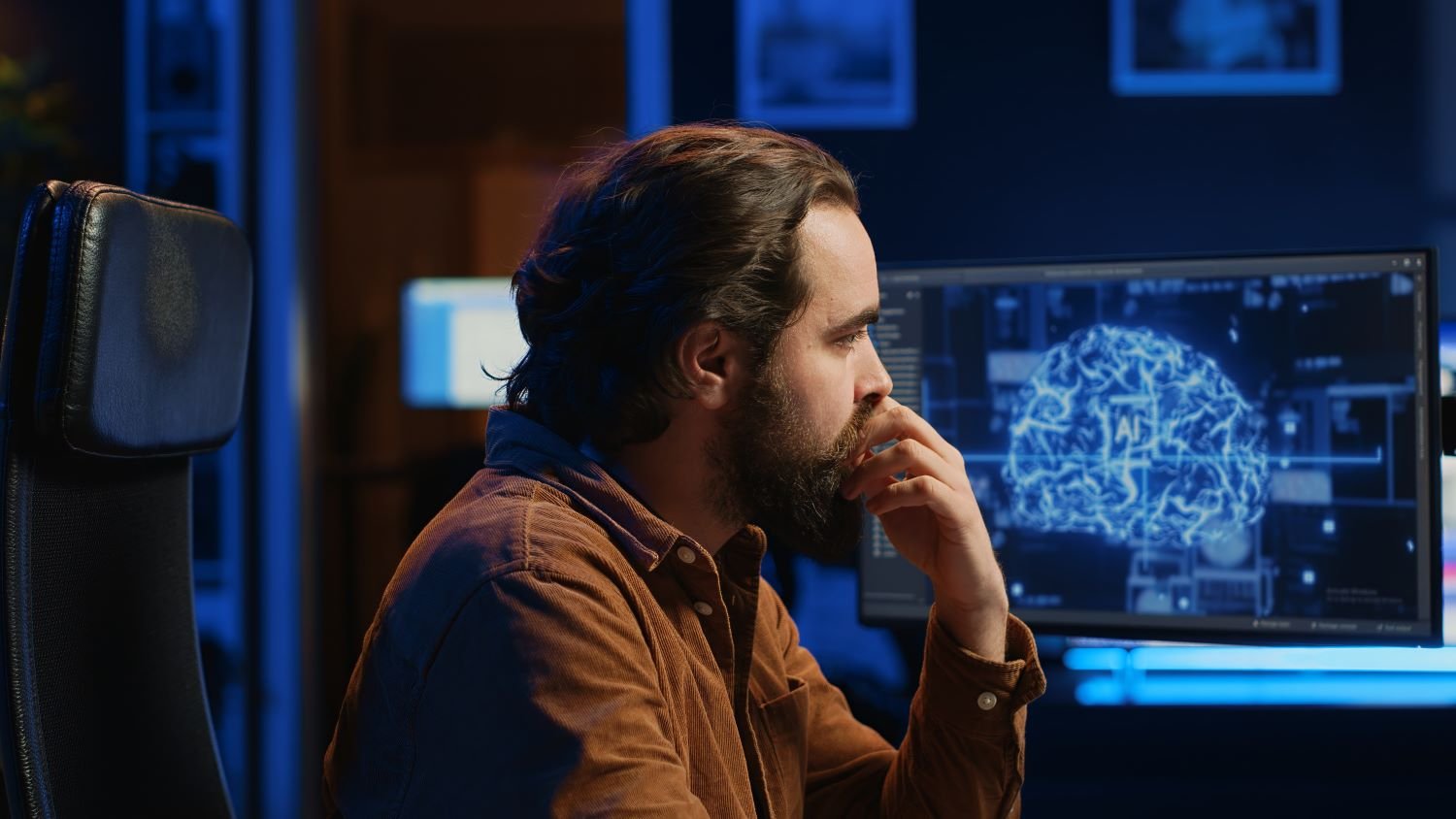
For most of human history, the brain has remained a black box—an intricate web of electrical signals too complex to interpret. Every thought, memory, and intention is encoded in microscopic pulses of neural activity. Scientists could measure those signals, but decoding them into meaningful language seemed impossible.
That is now changing.
Thanks to advances in artificial intelligence and brain–computer interfaces (BCIs), researchers are beginning to translate brain activity into words, images, and even full sentences. What once sounded like science fiction—“mind reading”—is becoming a clinical reality.
From Silence to Sentences: A Breakthrough in Thought-to-Text Technology
In 2025, researchers at Stanford University revealed a remarkable development. A 52-year-old woman, paralysed by a stroke nearly two decades earlier, was able to generate sentences using only her thoughts.
She couldn’t speak clearly. But when she imagined saying words in her mind, a small array of electrodes implanted in her frontal lobe detected the electrical signals produced by her neurons. An AI system analyzed those patterns and translated them into text in real time on a computer screen.
For the first time, her internal monologue appeared as readable sentences.
She was one of several participants in a clinical study, including patients with amyotrophic lateral sclerosis (ALS), testing whether neural activity linked to speech could be converted into language. The results were the closest scientists have come to decoding imagined speech directly from the brain.
What Exactly Is a Brain–Computer Interface?
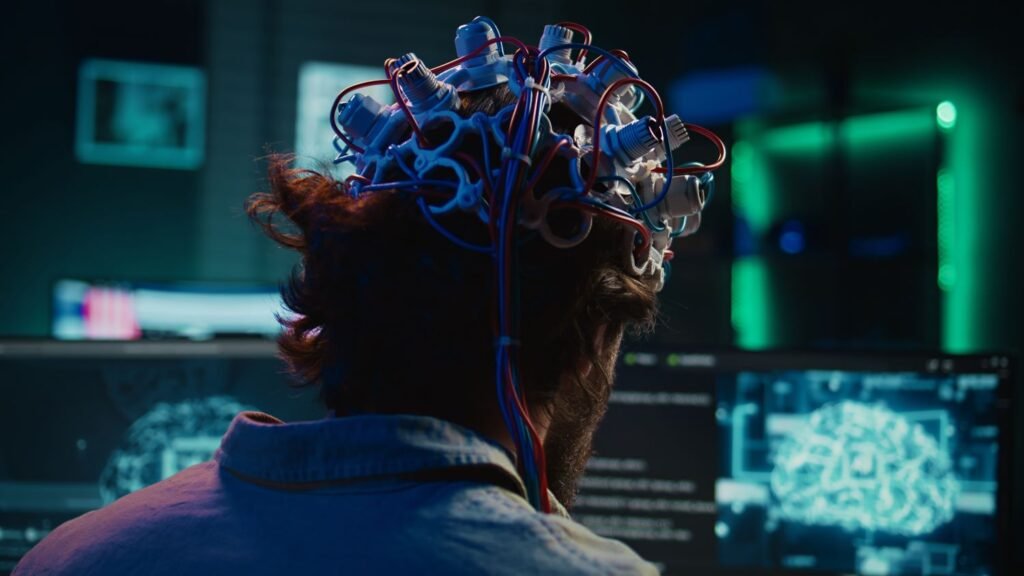
Brain–computer interfaces (BCIs) are advanced technologies designed to establish a direct link between the human brain and an external system such as a computer, prosthetic device, or digital application. Instead of relying on physical movement or speech, these systems detect neural activity and translate it into actionable outputs, enabling communication and control through brain signals alone.
They detect neural signals, process them through algorithms, and convert them into commands—such as moving a cursor, controlling a robotic limb, or now, generating text.
Although BCIs may seem futuristic, the concept has been around for decades.
In 1969, neuroscientist Eberhard Fetz demonstrated that monkeys could learn to control a meter needle using the activity of a single neuron—if rewarded. Around the same time, Jose Delgado famously showed that electrical stimulation could influence behavior, even stopping a charging bull mid-run.
For years, BCIs successfully decoded signals related to movement. Patients with paralysis have used them to control prosthetic limbs or move a cursor on a screen. But decoding speech proved far more difficult.
Speech involves complex, distributed neural networks. Unlike movement, which often corresponds to specific motor signals, language is abstract, layered, and deeply integrated across brain regions.
AI Changes the Game
The missing piece was artificial intelligence.
Modern machine learning models excel at pattern recognition. When trained on neural data, they can identify correlations between specific brain activity patterns and intended words or sounds.
In 2021, researchers at Stanford University demonstrated that a quadriplegic man could form sentences by imagining himself writing letters in the air. The system achieved 18 words per minute—slow compared to natural speech, but a major milestone.
Natural conversation typically flows at about 150 words per minute. So researchers aimed higher.
In 2024, a team at the University of California, Davis led by neuroengineer Maitreyee Wairagkar developed a system that translated attempted speech from an ALS patient directly into text. It reached approximately 32 words per minute with 97.5% accuracy—making it the first speech-focused BCI capable of supporting more natural communication.
This wasn’t typing letter by letter. It was decoding intended speech patterns directly from neural signals.
Beyond Words: Mind Captioning
Meanwhile, researchers in Japan introduced what they called “mind captioning.” Instead of decoding speech, the system reconstructed what a person was seeing or imagining.
Using non-invasive brain scans combined with multiple AI models, the researchers generated detailed descriptions of mental imagery. In essence, the technology attempted to translate visual thoughts into language.
While still experimental, such systems hint at a future where thoughts, images, and ideas could be externalized without physical movement.
From Research Labs to Commercial Reality
These developments are no longer confined to academic institutions. Companies are racing to commercialize brain–computer interface technology.
One prominent player is Neuralink, founded by Elon Musk. The company is developing implantable brain chips designed to help people with paralysis regain communication and mobility. Their long-term vision extends even further—toward enhancing human cognition and enabling seamless interaction between humans and machines.
According to experts in the field, large-scale deployment of certain medical applications may occur within the next few years.
Is This Really “Mind Reading”?
Despite dramatic headlines, it’s important to clarify what these systems actually do.
AI is not reading random thoughts or private memories. It decodes specific neural patterns associated with defined tasks—such as imagining speaking a known set of words. The systems must be trained extensively on each individual’s brain activity. They do not interpret spontaneous or unstructured thinking.
In other words, this is highly targeted neural decoding—not unrestricted mind access.
That distinction matters, especially as ethical debates intensify around privacy, consent, and cognitive security.
The Bigger Picture: What Comes Next?
For people living with paralysis or neurodegenerative disease, these technologies represent more than innovation—they represent restoration of voice.
Communication is fundamental to autonomy, dignity, and identity. The ability to express thoughts directly from the brain could dramatically improve quality of life for millions worldwide.
Looking ahead, the broader implications are profound:
- Hands-free interaction with digital devices
- Thought-controlled smart environments
- Advanced neuroprosthetics
- Potential cognitive enhancement
However, commercialization will require rigorous safeguards around data protection, informed consent, and long-term neural health.
The Brain Is No Longer Silent
The electrical crackle inside the human brain is still immensely complex. But what once seemed indecipherable is gradually becoming interpretable through AI-driven analysis.
We are not at the stage of reading every passing thought. Yet we are undeniably entering an era where internal language can be externalized—and silence can be transformed into speech.
For the first time, the boundary between mind and machine is becoming permeable.
And that may be one of the most transformative technological shifts of the 21st century.